

Writing fiction is a spiritual practice.
The rituals differ for each writer (early morning caffeinated typing for one, late night note-booking for another) but the process calls for monk-like devotion. Once in the flow state, where the creative entity seems to possess you, the experience is close to religious ecstasy.
It’s a magical feeling, and it was one of the things I had to stubbornly ignore when I was a precocious young atheist. You can probably come up with a materialist explanation about dopamine or serotonin or something. But there is something else there. You will never be able to “prove” it in scientific terms. Every writer or creative person, they know. You can feel it. It’s almost like the work wasn’t solely created by you. I’m not saying it’s God, or The Universe or the concept of the genii from antiquity. But creation itself seems shepherded by something diaphanous, outside your immediate sphere of consciousness.
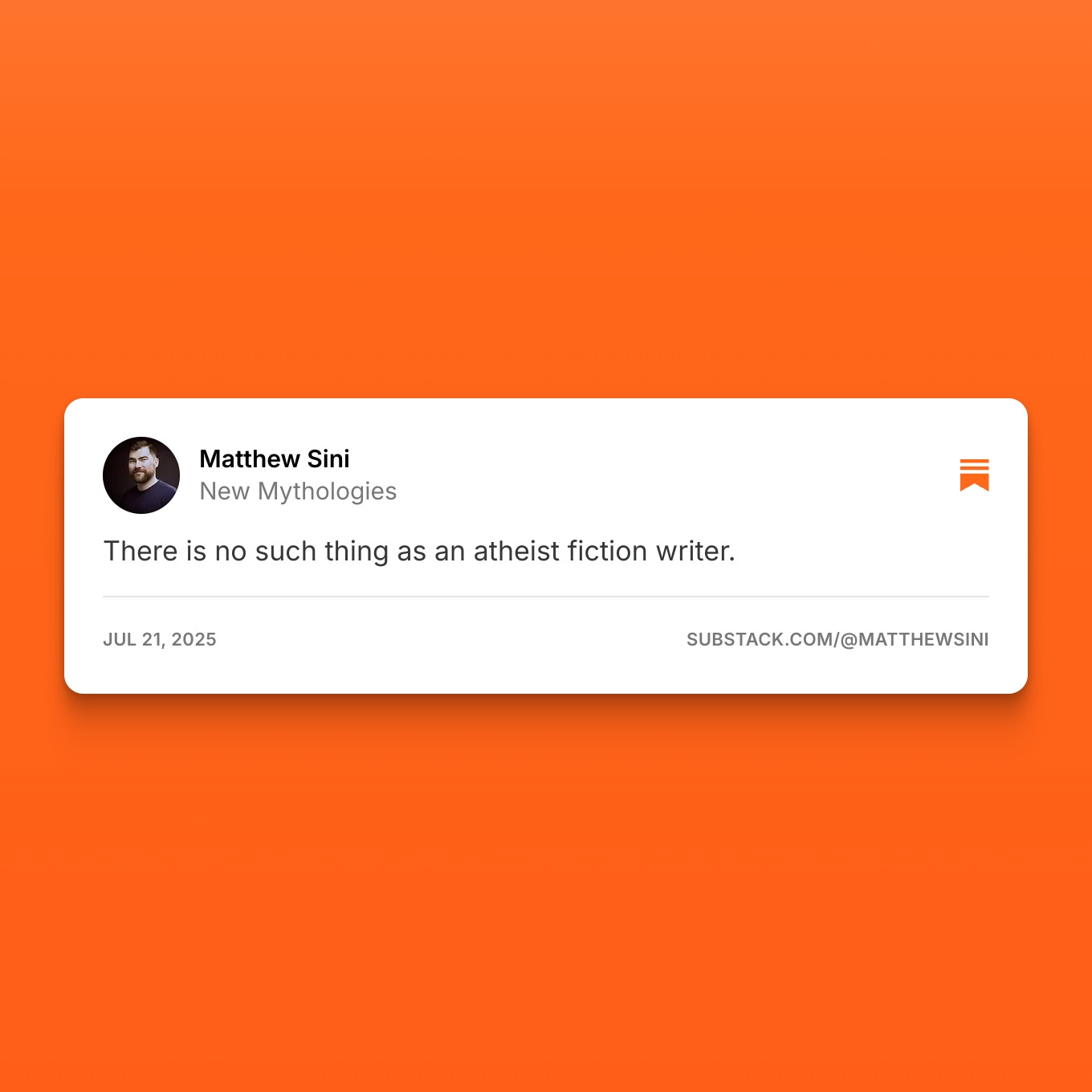
Self-described atheists betray their (un)belief the moment they create a fictional lifeworld. You can tell yourself you don’t believe in anything higher, but the minute you start sketching a character, naming a place, arranging a scene so that one thing follows from another, you’ve smuggled transcendence back in.
To write is not to make meaning but to discover it. Whether the inspiration is the social world at large, the depths of the human psyche, or the lumbering march of history, a novelist reaches for something larger. To envision a world beyond the limited material experience of the individual is already a kind of theological quest.
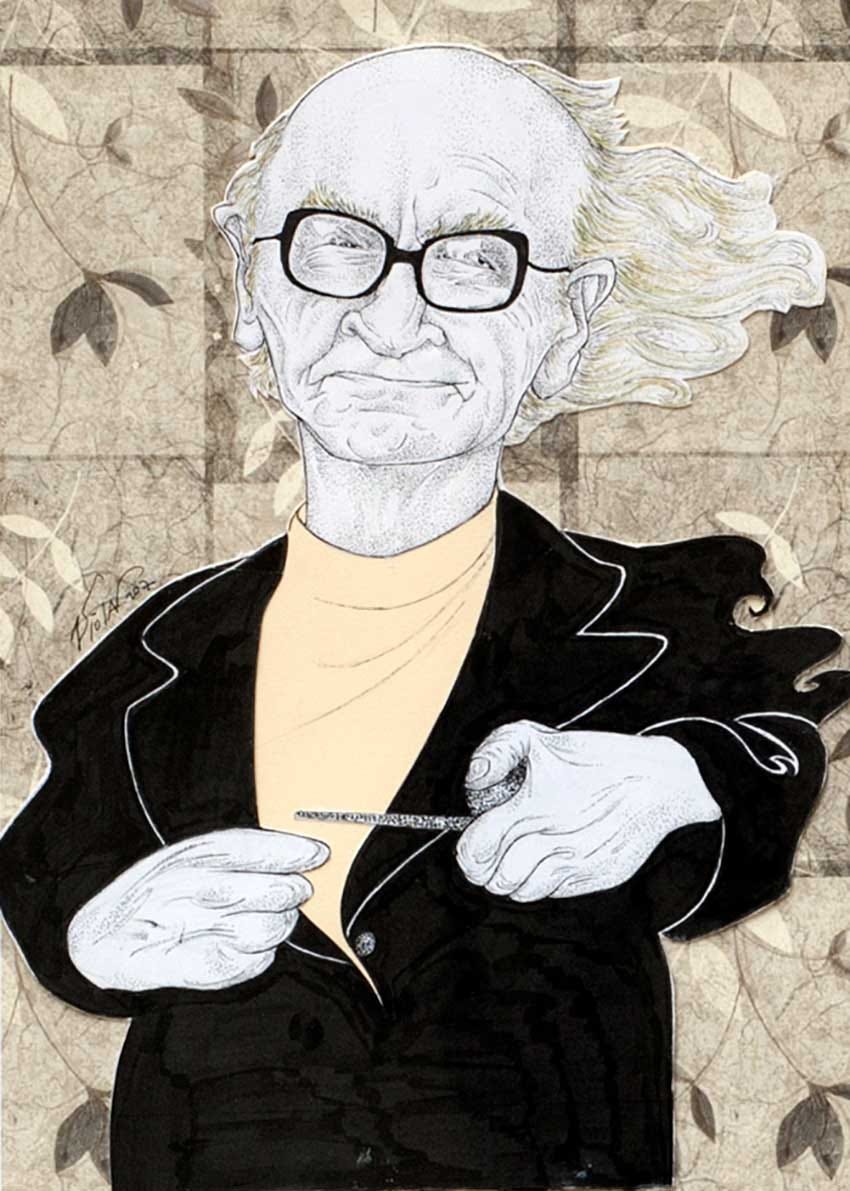
Historian of religion Mircea Eliade called such world-making hierophany, a manifestation of the sacred in ordinary reality. In traditional cultures, sacred stories were re-enacted in ritual cosmogonies that symbolically returned worshippers to the beginning of time, what Eliade called illud tempus, or “that time.” These rites both recalled a myth and renewed the cosmos in the present moment.
Even in a secular age the mythic impulse survives, migrating into art, dreams, and especially literature. A novelist confronting the blank page performs a small cosmogony the moment they begin to fill it.
A certain modern posture insists the universe is meaningless but that it is up to us clever primates with storytelling brains to make meaning ourselves. Camus made this the drama of The Myth of Sisyphus: the hero condemned to roll his boulder forever yet, by embracing the absurd task, carves out a sliver of dignity.
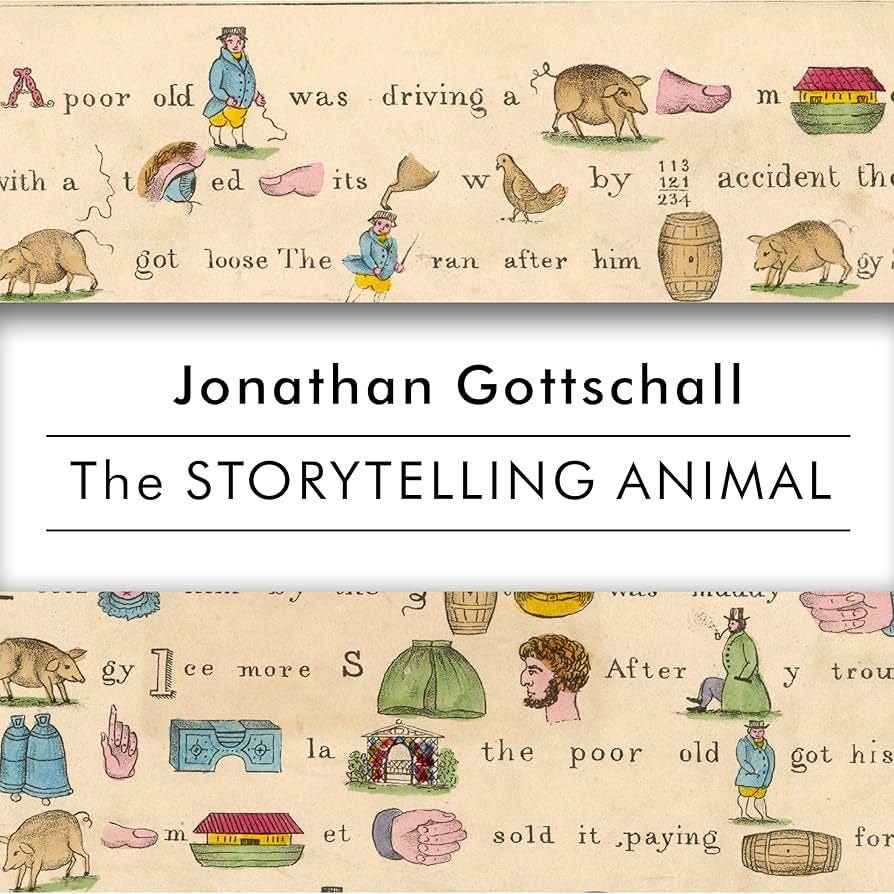
During my militant atheist phase, I got into the work of Jonathan Gottschall. He was one of the few avowedly atheist types who contended with questions in the arts and humanities. The New Atheists of the early 21st century were philistines. This is inarguable. Their worldview had no good account of art and culture. Though the likes of Richard Dawkins claimed they appreciated the beauty of religious art, this did not make religion true in their mind. But “beauty is truth, truth beauty,” as John Keats wrote. So there was never a serious attempt by these vulgar materialists to contend with art.
But in The Storytelling Animal, Gottschal gives it a red hot go. His account of storytelling offers an evolutionary gloss: narrative is the adaptive trick by which our species knits random events into plots so that we can cooperate, persist, survive. By following fictional characters through danger, conflict, and moral choices, we rehearse strategies for survival, empathy, and social cooperation without facing real-world risk. As Gottschal tells it, this is why so many stories feature trouble, threat, and struggle. I found it an interesting idea at one point. And I see some truth to it still. However, like the evolutionary theory it draws from, Gottschal’s explanation of narrative is about process, not being.
Both the existentialist and the more recent evo-psych accounts explain how we have come to “use” meaning in a supposedly meaningless world. But they fail to contend with the existence of meaning as such. The intelligibility and sheer meaningfulness of reality is an invisible given even as it’s dismissed.
If meaning is an evolved strategy or a heroic flourish against the void, then it is merely decorative. There’s no reason to prefer it to despair, no reason to call the gesture noble rather than delusional. The explanations may be compelling stories about the origin of stories, but they don’t justify the burden they place on us to keep telling them.
The novel presupposes meaning. This is its first condition, its contract with the reader. However plain its details or unglamorous its characters, a novel asks us to believe that human lives are weighty, and that their choices carry consequence. To read attentively is to consent to the idea that the texture of existence is charged with more than accident.
Even a novelist who claims to depict a meaningless world contradicts himself by writing at all. To intervene in the world by telling a story is already to suggest that the world is interpretable.
A novelist who denies the transcendent ground on which the novel rests is like a pilot who denies aerodynamics. They can come up with alternate explanations for why things work the way they do, but their practice relies on that which they deny.
If the universe is without purpose, if love, grief, and justice are merely evolutionary tactics then why should we treat the struggles of fictional people as anything but elaborate play-acting? Why should betrayal wound if loyalty is just primate instinct? Why should death sting if it leads nowhere at all? What matters? Why act? What is worth suffering for?
These are theological questions before they are aesthetic ones. A writer needn’t supply answers, or even settle on a specific belief in the divine, but they have to acknowledge this is the metaphysical sandpit in which they’re playing. As Eliade put it, “myths and symbols survive in literature… even the most non-religious man retains traces of mythic behaviour.”
This is why so many of the greatest novels have been written by religious believers, or at least writers tormented by belief. Dostoevsky’s The Brothers Karamazov is unthinkable without God. Its murders and confessions make sense only in the light of eternity. Flannery O’Connor’s grotesque Southern tales rely on grace penetrating the everyday at odd, violent angles. Even Melville, in Moby-Dick, cannot help but invoke the abyss as the measure of man. His formative Calvinism shaped the book’s relationship to the grisly reality of “fate.” Later, doubt itself becomes a form of faith, an apophatic theology carved into the leviathan’s body.

The atheist novelist must write with the grammar of transcendence while disowning its source. Likewise, in the materialist world of the nonbeliever, morality cannot be justified beyond personal hedonic preference. So the inherent moral consequence many of them aim for in their books is merely ported—often unthinkingly—from their society’s religious substrate.
In Camus’ The Stranger, Meursault shoots an Arab on a beach and discovers that neither remorse nor redemption awaits him. Life is stripped of justification, leaving only the stubborn posture of defiance. Sartre’s Nausea is bleaker: objects ooze with contingency, existence itself sickens the narrator, and freedom appears as a curse of endless, meaningless choice.
These books are elegies for transcendence, hymns to a vanished God. The shadow of meaning looms larger because the authors claim to have banished the source of it. Camus and Sartre cannot help but write in a register of tragedy, and tragedy presupposes that human life is not trivial.
Back in the nineteenth century, George Eliot (Mary Ann Evans) abandoned her juvenile evangelism, but remained a moral realist in her fiction. Influenced by David Strauss and Ludwig Feuerbach, she was convinced human sympathy and ethical seriousness could survive the death of God. Her most well-known novel, Middlemarch, treats ordinary lives with an almost sacramental attentiveness. Yet even here, one senses the strain. Eliot’s secular ethics only work because she continues to write as if human dignity and moral consequence were woven into the structure of reality, an inheritance from the Christian faith she shed.
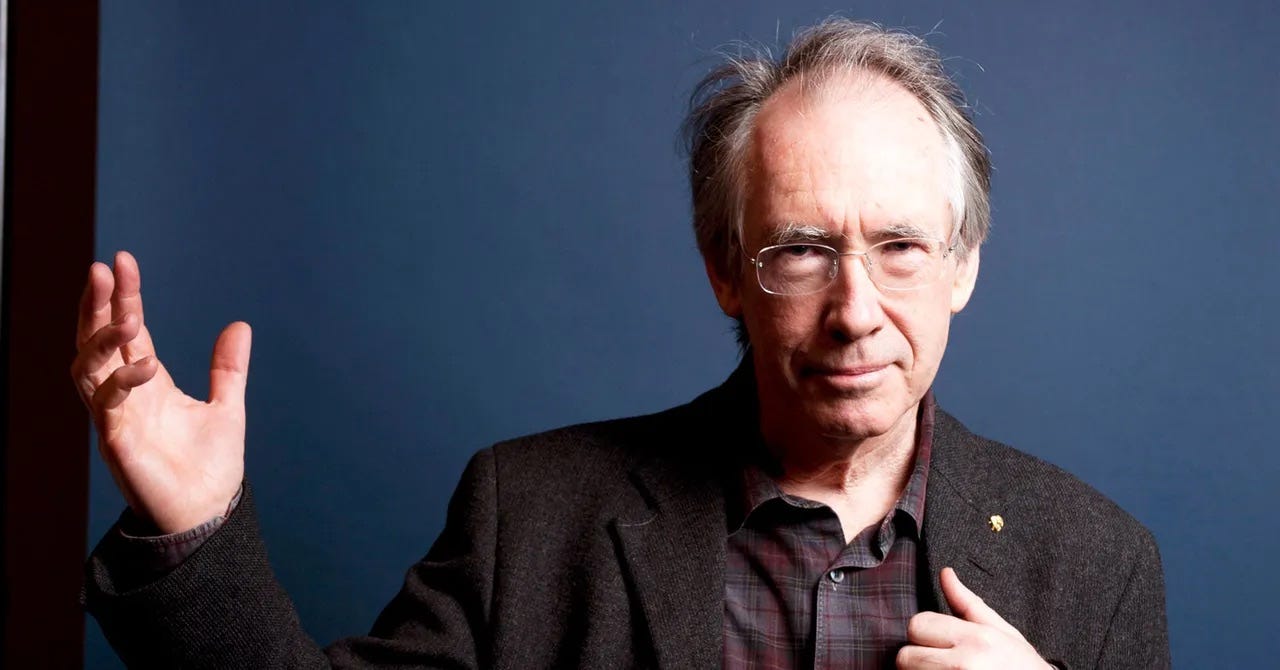
In Ian McEwan’s Atonement, he stages the consequences of a single false accusation across decades, blending metafictional games with moral seriousness. In Saturday, McEwan gives us a day in the life of a London neurosurgeon, complete with the intimations of terrorism and domestic fragility. But in the end, why should these atheistic dramas matter? In interviews he has been blunt about his beliefs, reducing morality and art to a neurological byproduct of evolution.
Philip Pullman’s His Dark Materials trilogy was conceived as a rebuttal to C.S. Lewis’s Narnia books. God, in Pullman’s cosmology, is a fraud: an aged and impotent angel propped up by lies. The heroes overthrow heaven itself to secure freedom for humanity. But freedom for humanity in this world is just secular humanism. And secular humanism is ethically grounded in Christian precepts: the sanctity of the individual person, the imperative to improve the world, the focus on sincerity and authenticity of the inner life. But none of these precepts have any ethical weight when they’re divorced from their religious context. His Dark Materials wants the transcendent grandeur of epic, but has sawed off the branch it sits on. The moral passion of Pullman’s world is borrowed from the tradition it denounces.
What makes these “godless” novels compelling is not the flatness of their creed but their continued ritual form: the tragic arc of death, hope, and redemption. They still maintain the sacred practice of story while denying that anything is actually sacred.
After his conversion, T.S. Eliot argued that art and culture couldn’t ultimately thrive in a secular vacuum. The secular materialist might still create, but over time the works would grow thinner, less resonant, detached from the deep roots of meaning. But the way things have shaken out is both more perverse and more promising. Art as spiritual practice persists, replaying Eliade’s “that time” again and again. But its godless practitioners either don’t know they’re doing it or don’t want to admit they are.
To write a novel is already to cross the threshold into the sacred. Shaping letters into thoughts and worlds is literally a cosmogonic act. However stridently the author denies transcendence, the practice of fiction draws them back to it. Whether they know it or not, every novelist is a hierophant, staging rituals of meaning even in a culture that pretends not to believe in them.
All humans have religious faculties, so the problem with atheism in writers is that it’s a bit like handicapping yourself for no necessary reason. It’s like a writer who decides to arbitrarily exclude all sexual content from their work - which in practice many do and have done, but it’s either going to fall flat or come out in weird ways. To extend the metaphor a bit, it’s sort of like Henry James - nothing explicitly sexual is ever depicted, but it leads to bizarre works like THE SACRED FOUNT where the scrupulous absence turns into a kind of derangement.
The caveat we’d add here is that “religion” doesn’t necessarily imply “transcendence” (in the Platonic or, in practice, usually Neoplatonic sense). What an Immanent, non-Platonic religious (or occult) metaphysics would imply for “literary fiction” has in practice barely been seen (English language fiction is only a few hundred years old, although we can check out the Chinese classical novels for some intimation of what it might look like…spoiler alert, it doesn’t look like anything the mainstream is going to like).
I wonder if a case can be made that a specific type of religious belief is more likely to produce great art? Hear me out...Christianity made human life a drama. Every person lives with the possibility of being saved or damned for all eternity. Thus individual choices really mattered and therefore became interesting. Compare that to the ideas of Confucius with its emphasis on harmony, or Hinduism and its great impersonal wheel of Karma. Might explain why certain cultures produce more great novelists than others. Just a thought.