

Many writers seem fated to become creatures of their epoch. You can’t not be a product of your time, but even if you wilfully aim to transcend it, you will never know if you succeed. This is the tragedy of the writer who wants to be read.
More tragic is the growing number of writers who willingly throw themselves into the now. They trade being remembered for being known. It’s a kind of literary marshmallow test1. In the pursuit of “currentness”, they embrace a preoccupation with day-to-day minutiae—often political—with no eye for posterity. But posterity is what it’s all about, baby! This may sound grandiose, but it’s true. And a writer who claims otherwise is either lying to you or himself. Too many writers shrink down into faux-humility about their work. And in doing so, they are little-ol-me-ing their way into the annals of obscurity.
For the contemporary writer, posterity is suspect and or repressed. Because it implies a bridge between those who came before you and those who will come after you. Within this worldview, literature that came before is not just an anxiety as Harold Bloom tells it2, but something to be “always already” interrogated, questioned, subverted. The traditional is lampooned, derided as fusty, irrelevant, and benighted. Today’s literary disconnection from the past is in some sense a perversion of the Modernist project. Ezra Pound said “make it new”, not ignore the old. Without a long tradition to draw on, there would be no It to make new.

The Current Thing writer does not bother considering their place in history. They are concerned with their place in the increasingly zero-sum status game of publishing. If not influenced by social media, they’re certainly shaped by its attentional logic: the hottest take, the most searing critique, the most “important” story about some increasingly arcane pathology: incels this month, furries the next.
We’re talking about hacks here, of course. I name them with no judgement. I myself wrote for a tabloid to pay the bills. It’s easy work if you’re good with words. And look, hackery too has its own tradition. It financially sustained a lot of the greats—Wilde, Orwell, Didion, Dickens, and so on.
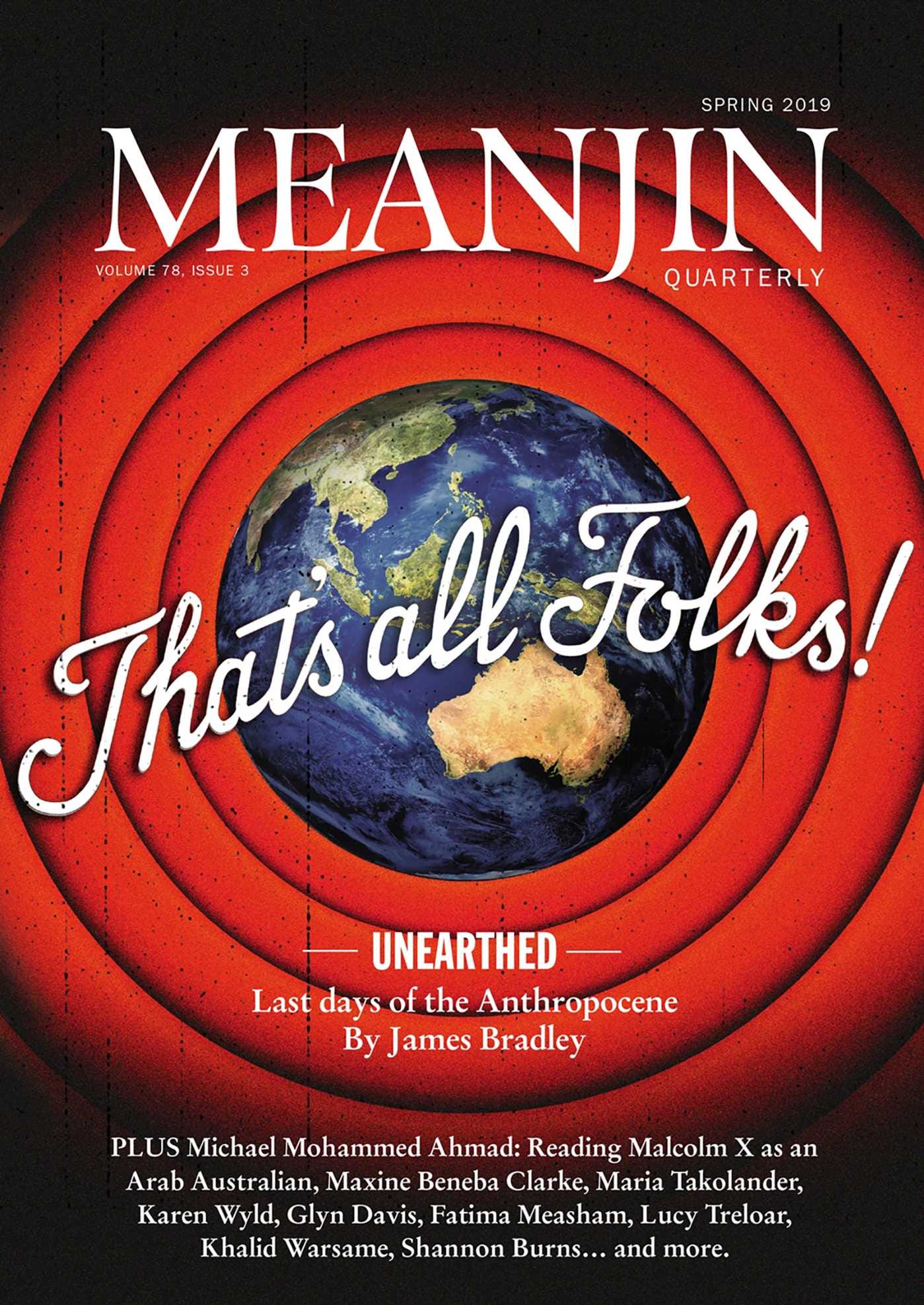
It is a long bow to claim that Current Thing writing (the evolved form of hackery) is a key part of our cultural heritage. But that’s the angle Australia’s literary scene have been taking after the recent announcement that Meanjin will be shutdown.
The literary journal, founded in 1940 by Brisbane-based journo Clem Christesen, quickly became the country’s platform for serious creative work. Prior to this, so much of Australia’s intellectual and cultural life was imported from Britain. Up until the 1970s, many aspirant writers had to go abroad to have any sort of career. Christesen helped change that with a publication that was both sophisticated and unapologetically Australian. The journal’s very name comes from an Indigenous word for an area of Brisbane, tying the publication to Australia’s pre-colonial history.
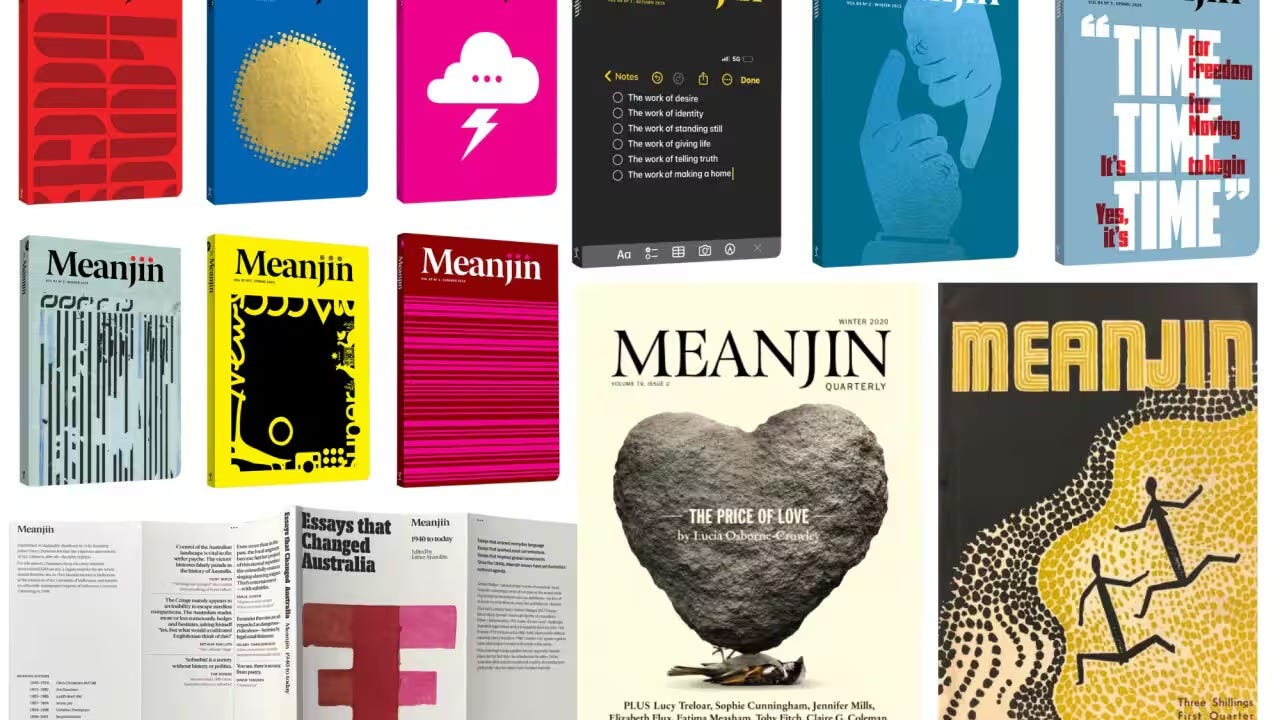
After moving the operation to Melbourne post-WWII, the journal nurtured many of our greatest writers. Over the years, it published Judith Wright, Patrick White (our only Nobel Laureate), Gerald Murnane, David Malouf, and Helen Garner. Oh and let’s not forget Yours Truly3 has also graced its pages.
But something happened in the 2010s. It happened to Meanjin and it happened to literary journals in Australia and all across the world too. Cultural commentary, essay, and memoir came to dominate the pages of publications that once had hefty amounts of fiction.
Go to the Meanjin website right now and peruse the table of contents for the recent issues. As a rule, there are about four short stories each issue. FOUR. Once the crucible for Australian myth-making, now the journal seems unwilling to make substantial creative additions to the nation’s culture. And while there is plenty of poetry, much of it is of the haranguing type that may as well be a lecture. The Current Thing mode rules. The vast majority of the journal’s content is either personal essays or portentously-presented issue-essays about why climate change is racist. Even the short stories tend towards issue-stories.
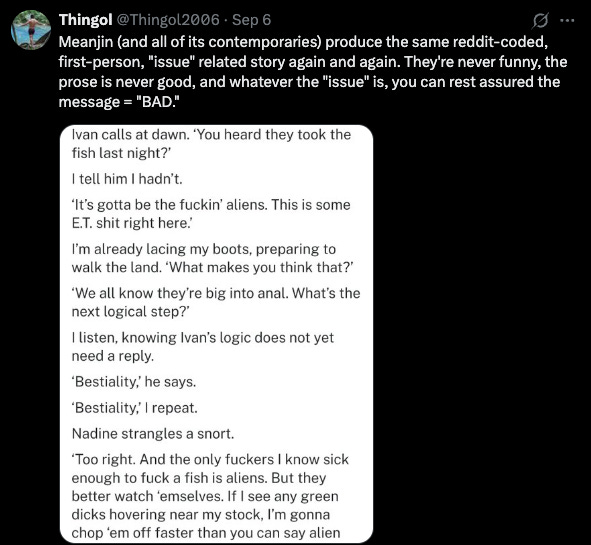
At some point, literary journals decided to morph into misshapen, pitiful things combining the worst aspects of Jezebel-tier thinkpieces, Washington political magazines, and social media oversharing. If you’ve read a literary journal lately, you know exactly what I’m talking about.
From what I can gather, this change in content was a way to lure in social media-addicted readers looking for more takes. The thing about takes though, is they are fleeting and better suited to scroll-engagement. Literary journals transformed from objects in the world to just another link on the feed. Like so much else.
But literary journals were never going to attract scrollslop zombies. I run a popular literary podcast4. I promote it on all social media. Almost none of my audience comes from Xitter or Instagram. It’s all organic, people searching for books podcasts on their podcatchers. Literary journals have beclowned themselves trying to tap into the attention economy. It was never going to work because a journal is not a feed, and it is depressing to see such institutions debase themselves in such a way. I speak here not just of promotional endeavours, I mean the sloppification of the journal’s content too.
The political expressions of Current Thing writing are not solely leftist—many right wing publications are exasperatingly discourse-heavy—but most literary journals are publicly funded institutions and publicly-funded institutions lean left. What this means is that the Current Thing writing in these places is always of a particular rhetorical flavour. To Meanjin’s credit, it has published writers across the political spectrum, especially under Jonathan Green’s editorship (2015-2022). But generally, it’s politics are unsurprisingly, boringly progressive.
One allegation in the commentary around the closure is that it’s punishment for the journal’s forthright discussion about the Gaza-Israel conflict. The University of Melbourne, it is claimed, is shutting Meanjin down because it has published essays critical of Israel.
The University itself cites “purely financial” reasons for the closure. But many in the mainstream publishing industry have questioned this. Author Anna Krien said, “the public statement that this turn of events is a financial decision is laughable. I highly doubt Meanjin, in its entire 85 years, has ever made money.”
A continual refrain from these literati is that the university could use some of its large surplus to subsidise the publication. I tend to agree. Meanwhile, the Melbourne University Press chief executive and publisher argued that “the financial pressures of publishing a literary magazine in today’s world, however, are inescapable and considerable, and the readership is shrinking.”
Alongside the sentiment that the university’s publishing arm can afford to keep it going, critics excoriate the decision as an attack on Australian cultural heritage. It’s been a delectable irony to see people who openly despise the nation of Australia argue on cultural nationalist terms.
One of the journal’s regular contributors, Claire G Coleman, expressed her disgust on Bluesky (lol), saying that the cancellation was “cultural vandalism of the highest order.” Ms Coleman also claimed in the pages of Meanjin four years ago that “Australia is a lie, built on a foundation of lies so deeply embedded in its soul they pollute all that the nation is.” Shouldn’t she be happy that cultural vandalism has been conducted on a national heritage “built on lies”?
Cries of “cultural vandalism,” “but muh cultural heritage,” “Australian culture will be impoverished” from people who don’t believe the nation of Australia has any legitimacy. Of course, they still take money funnelled into grants, universities, and other institutions, levied from taxpayers who do believe in the nation’s legitimacy.
It is unsurprising that there has been no great outcry about Meanjin’s cancellation beyond the literary sphere. There is never any attempt by these types to actually engage with the broader public. The only time we see them do this is when their funding is under threat. And then they become blood and soil true blue Aussies defending our CULCHA, mate! But this is their bad faith attempt to get the wider public—which they despise—on side.
Cultural institutions are infested with people who hate the nation to which they’re attached. They spend much of their time shitting on the people and culture that made the institution possible. They fill the pages of the country’s literary journals with discourse discourse discourse, nothing truly creative or generative. They create nothing new for their fellow citizens to enjoy. Because of their presentist outlook, they simply don’t believe in cultural heritage.
And an institution that doesn’t believe in cultural heritage will not find many friends in the culture at large.
Unlike some Australian writers here on Substack, I don’t celebrate this news. I think it’s sad. I want my country to have a thriving culture. The problem is the people in charge of these institutions are myopic, have no strategic nous, and are incredibly elitist while having awful taste. I am not just talking about the funding bodies here. I mean the editors, publishers, so-called critics and most writers too.
The custodians of our culture should actually like and respect it enough to not expose it to so much Current Thingism, that miserable plague of the now. If you do believe in cultural heritage, you have to make stuff that people will look back on and appreciate, if not enjoy. That means stories, fiction, myths. New creation not news reaction.
The Current Thingism of latter-day Meanjin is so tragic precisely because it is a betrayal of Christensen’s original vision for the journal to channel the Genius Loci, or Spirit of Place. To say nothing of the bloody irony of eventually locating a journal called Meanjin in Melbourne/Naarm…!
Current Thingism maps neatly instead to an obsession with the Spirit of Time (a.k.a the Zeitgeist) which is presentist, accelerating, modernist — modernism being etymologically related to mode, as in ‘à la mode’. Survival and currency in the attentional economy was one reason for this shift, but I think it also just speaks to a fundamentally progressive view of civil society and its institutions; a view whose pedigree can pretty easily be traced back to fundamentally Whiggish notions about how societies and histories ought to and do progress.
Having this disposition at the editorial level filtered down to the kinds of writers who were overwhelmingly platformed. As noted, many saw value in Australian institutions (civic, literary, social, economic) only insofar as they could be deployed inwards and against themselves in deconstructive fashion. But of course, when you own the toys, you wouldn’t call it ’cultural vandalism’ even if, substantially, that’s what it is. It only gets that label when someone takes your toys away from you and starts doing it back!
This self-abnegating, self-effacing rot has permeated vast swathes of the Australian cultural landscape, even beyond the literary scene. White-ant curators and commentators and influencers eat away at the foundations of any distinctive Australian culture, setting it up to to be blown over by a stiff gust of wind and replaced by whatever the latest internationalised trend is that sweeps in from Empire’s algorithmic core.
The deepest irony must surely be that most of the contributors to Meanjin show no understanding whatsoever of the seminal Phillips essay on the Cultural Cringe — originally published in Meanjin — because they are some of its foremost exemplars today.
This is what Murnane himself hyperbolically captures in The Plains when he distinguishes the deep Inner Australia from the cosmopolitan coastal cities which are too anxious about their place-in-the-world to even understand or appreciate their place as-it-exists in the world (that is, to discover the Spirit of Place).
Best take on this i've read so far